The actions of Israel against the aid flotilla headed to Gaza should be no great surprise. If you accept enough premises, you can justify almost any conclusion. The Zionist premise is that God gave them Palestine and the non-Jewish elements are there on sufferance. They cannot accept the notion of large numbers of people who hate them occupying much of Palestine and governing themselves. So they accept any method to defeat this result.
In fact, since the first establishment of a Zionist state in an Arab region, this outcome has been pretty much inevitable. The Palestinians are going to hate them and there are too many to drive away. Eventually, they will have a state and they will deeply hate Israel, even if they decide they need to do business.
Now consider Afghanistan. We refuse to contemplate a country governed by people who once allowed Osama bin Laden to hang out, so we try to change the country through war even though this won't work. We assume that given enough time, money, and American knowhow, anything is possible. All the evidence to the contrary will not change our leaders' minds.
The American view of nuclear weapons is going to be very difficult to sell in the UN now. Everybody knows Israel already has them. We want everyone to view Iran as the worst possible country in the Middle East to have nuclear weapons. Today, do we think this is going to fly?
We are living with North Korea's having nukes. We've lived almost 50 years with China having them. Pakistan and India live with the fact that each of them have them. Do we want Iran to have nukes? Of course not. Is it tolerable? Of course it is, and we will soon need to tolerate it.
Monday, May 31, 2010


Saturday, May 29, 2010
David Brooks Scores Again
In his latest essay, David Brooks is at his best, looking at the nature of risk management in a complex world. He offers some advice on directions we should collectively take. I'd like to think we will, but I don't.
Mexicans Boycott Arizona. Not a problem.
There appears to be a movement by Mexican musicians to boycott performances in Arizona. I don't think they're getting the message. The majority of Arizonans will not miss them. And, in fact, if they can persuade their fellow Mexicans to stay out of Arizona, the citizens of Arizona are likely to feel that they got the job done.
Arizona police are not going to harass everyone who looks Hispanic. If you are legitimately in Arizona, you probably speak decent English. If you look Mexican and don't speak English and have no paperwork, there's a damned good chance you're illegal.
Arizona police are not going to harass everyone who looks Hispanic. If you are legitimately in Arizona, you probably speak decent English. If you look Mexican and don't speak English and have no paperwork, there's a damned good chance you're illegal.
When The Free Market Isn't Enough
The news the BP chose a riskier but cheaper approach to their well shouldn't be a shock. The world works on the sum of individual decisions, and individuals know more about what they are doing than the higher bosses, let alone investors. So when people drilling in the deep ocean look at decades of success, they will ask themselves whether it's more profitable for themselves if they cut corners.
Not whether it's better for the public, because that's abstract. What's concrete is that if you do a job for another year in a manner that has been successful for 20 years, you'll get paid. If you insist on safety measures that nobody understands the need for, you may get fired. And if you guess wrong, you can take your savings and go to Montana.
But would regulation have prevented the blowout? Is it likely that regulators will know what all the issues are, let alone the appropriate level of safety required? Unlikely.
At the end of the day, the lessons is mostly that this is a very uncertain world, where doing things on a large scale must involve large risks and we should prepare ourselves for mishaps. The lesson the most people are likely to take away is unfortunately that we should stop drilling in deep water.
Not whether it's better for the public, because that's abstract. What's concrete is that if you do a job for another year in a manner that has been successful for 20 years, you'll get paid. If you insist on safety measures that nobody understands the need for, you may get fired. And if you guess wrong, you can take your savings and go to Montana.
But would regulation have prevented the blowout? Is it likely that regulators will know what all the issues are, let alone the appropriate level of safety required? Unlikely.
At the end of the day, the lessons is mostly that this is a very uncertain world, where doing things on a large scale must involve large risks and we should prepare ourselves for mishaps. The lesson the most people are likely to take away is unfortunately that we should stop drilling in deep water.
Wednesday, May 26, 2010
Dump Potiowsky
I've been watching the pattern of Oregon state tax revenue forecasts ever since the first time I ran for the Lane Community College Board. The person in charge for most of that time, except for an interim where he went back to academia, has been Tom Potiowsky. If nothing else, my observations have convinced me that Oregon should be cutting waste and inefficiency in order to balance the budget, starting by firing Mr. Potiowsky.
Yesterday, he announced that the revenue forecast for 2009-2010 was being reduced by a half billion bucks from what he had said three months earlier. He said this in an environment of no major surprises. No new flu epidemics. No wars or terrorist attacks. Nothing. But after three months, critically the three months during which the legislature went home thinking they'd done their job, the forecast plummets.
The problem is that the state's Democrats will spend almost every nickel that isn't nailed down, and the Republicans are so distrustful that rather than trying to nail much down, they prefer to ship it back to the taxpayers, especially since this earns them political points. A reasonable state operation would, after 150 years, have set aside enough reserves that it could proceed calmly through a biennium, spending what it estimated and handling noise in the revenue stream with reserves.
But this isn't going to happen. Nevertheless, if we're going to act stupidly we might as well save money. Let's get rid of the state economist and simply project Oregon's revenues to vary from the previous biennium by the average amount that CA and WA are estimating their own changes. I don't think we can do any worse, and it irritates me to think that our taxes in future years will be spent covering the amount of Potiowsky's PERS pension that we're not currently funding.
Yesterday, he announced that the revenue forecast for 2009-2010 was being reduced by a half billion bucks from what he had said three months earlier. He said this in an environment of no major surprises. No new flu epidemics. No wars or terrorist attacks. Nothing. But after three months, critically the three months during which the legislature went home thinking they'd done their job, the forecast plummets.
The problem is that the state's Democrats will spend almost every nickel that isn't nailed down, and the Republicans are so distrustful that rather than trying to nail much down, they prefer to ship it back to the taxpayers, especially since this earns them political points. A reasonable state operation would, after 150 years, have set aside enough reserves that it could proceed calmly through a biennium, spending what it estimated and handling noise in the revenue stream with reserves.
But this isn't going to happen. Nevertheless, if we're going to act stupidly we might as well save money. Let's get rid of the state economist and simply project Oregon's revenues to vary from the previous biennium by the average amount that CA and WA are estimating their own changes. I don't think we can do any worse, and it irritates me to think that our taxes in future years will be spent covering the amount of Potiowsky's PERS pension that we're not currently funding.
Thursday, May 13, 2010
Palin Makes Inteligent Support Difficult
On a day when Sarah Palin said something rare that I could support, namely that Highland Park IL is being stupid in not sending its girls basketball team to play a game in Arizona due to that state's law on illegal immigrants, she follows up with nonsense.
Noting the school has allowed student trips to China, Palin questioned whether school officials knew “how they treat women in China.”
Women? China denies many freedoms to its citizens, but I hadn't heard anything about women in particular. The only thing I can think is that she is referring to the country's aggressive campaign to limit the size of families.
China has one and a third billion people and a very urgent need to cap that. Should we be pleased if they let matters run their course and went for two billion?
A reasonable comment would have been that China suppresses its ethnic minorities, which would be a good analogy with Arizona. Instead, she shows that she is less opposed to curtailing human rights than birth control. She still stops my list of dangerous politicians.
Noting the school has allowed student trips to China, Palin questioned whether school officials knew “how they treat women in China.”
Women? China denies many freedoms to its citizens, but I hadn't heard anything about women in particular. The only thing I can think is that she is referring to the country's aggressive campaign to limit the size of families.
China has one and a third billion people and a very urgent need to cap that. Should we be pleased if they let matters run their course and went for two billion?
A reasonable comment would have been that China suppresses its ethnic minorities, which would be a good analogy with Arizona. Instead, she shows that she is less opposed to curtailing human rights than birth control. She still stops my list of dangerous politicians.
Sunday, May 02, 2010
The Intractable Greek Problem
Everybody is getting into the act, with headlines that joke about Greek gods and phrases like "Acropolis Now." OK, the parody of "Apocalypse Now" is not new, but the meaning is.
Paul Krugman, writing in the New York Times, bemoans the fact that the Greeks, by joining the eurozone, gave up the freedom to solve their crisis by devaluing the currency. He seemed to suggest that all they got in return was some prestige, which wasn't worth what they gave up.
But when they gave up the right to "fix" their economy with devaluation, they gave international investors the confidence to buy their government bonds at rates comparable to what would be charged Germany. The assumption was that the return on such bonds would be safe because the government could neither devalue nor default. Greeks saved a ton on interest.
However, the Greeks lied and cheated. They never qualified for membership without cooking the books and they have run deficits that they hid.
The technique which Krugman thinks so highly of is one that screws the international investors, who eventually get back their money in Greek currency but it's worth less than when they loaned it.
I don't see the exit plan. Loaning Greece money in euros, while the economy deflates, means that later they won't be able to repay the principal. Greece has a bloated civil service with cushy retirement plans. They need a more active private sector producing goods and services to be sold to foreigners, but this isn't likely to happen during the forthcoming austerity period. Whatever happens, it's likely to be ugly.
Paul Krugman, writing in the New York Times, bemoans the fact that the Greeks, by joining the eurozone, gave up the freedom to solve their crisis by devaluing the currency. He seemed to suggest that all they got in return was some prestige, which wasn't worth what they gave up.
But when they gave up the right to "fix" their economy with devaluation, they gave international investors the confidence to buy their government bonds at rates comparable to what would be charged Germany. The assumption was that the return on such bonds would be safe because the government could neither devalue nor default. Greeks saved a ton on interest.
However, the Greeks lied and cheated. They never qualified for membership without cooking the books and they have run deficits that they hid.
The technique which Krugman thinks so highly of is one that screws the international investors, who eventually get back their money in Greek currency but it's worth less than when they loaned it.
I don't see the exit plan. Loaning Greece money in euros, while the economy deflates, means that later they won't be able to repay the principal. Greece has a bloated civil service with cushy retirement plans. They need a more active private sector producing goods and services to be sold to foreigners, but this isn't likely to happen during the forthcoming austerity period. Whatever happens, it's likely to be ugly.
Thursday, April 08, 2010
The Qatari Diplomat did not cause an incident
Despite the news reports, nothing whatsoever happened on the plane that was diverted to Denver. The diplomat may have been sneaking a smoke in the lavatory, but the "incident" evidently was when asked, he said something like, "I was trying to set my shoes on fire." So all hell breaks loose.
Somebody at TSA or Homeland Security or wherever needs to look at the record of people who are in airports or on airplanes and make jokes about bombs. To date, over say the last century, there is no instance of someone making a joke who was actually serious. In the first place, it doesn't make any sense. More importantly, it never happens.
So a rational person, hearing the Qatari diplomat make a joke, would lean back and say to himself, "Well, at least I can feel confident that this guy isn't going to set off a bomb." Instead, we scramble the air force.
Somebody at TSA or Homeland Security or wherever needs to look at the record of people who are in airports or on airplanes and make jokes about bombs. To date, over say the last century, there is no instance of someone making a joke who was actually serious. In the first place, it doesn't make any sense. More importantly, it never happens.
So a rational person, hearing the Qatari diplomat make a joke, would lean back and say to himself, "Well, at least I can feel confident that this guy isn't going to set off a bomb." Instead, we scramble the air force.
Sunday, April 04, 2010
Lessons from Lewis Carroll
"In the midst of the word he was trying to say, in the midst of his laughter and glee,
he had softly and suddenly vanished away, for the Snark was a Boojum, you see."
A word of caution is in order. Arctic ice extent is a Boojum. Many climate skeptics are entirely thrilled at the March anomaly, and it's not irrelevant. But as Serreze is being forced to acknowledge prior anomalies, we should not forget that this is one as well. Just a few months ago, Arctic ice extent was running lower than ever for the date. Now it's the highest in years, but past experience says that there will faster melting through June, when the extent seems to be roughly the same every year, and what happens afterwards isn't much affected by what happened in March.
We're seeing an increase in Bering Sea ice. Elsewhere in the Arctic, temps are above normal but not enough to melt any of the solid cover. The Bering ice will soon melt and the other Arctic ice may be setting up for a serious decline as well. Those who trumpet the "return to normalcy" may wind up like the Baker.
Although maybe not. An odd event may represent a fundamental change in pattern, or it may just be odd. A real skeptic reserves judgment, even while perhaps hoping deeply for a colder Arctic ASAP.
he had softly and suddenly vanished away, for the Snark was a Boojum, you see."
A word of caution is in order. Arctic ice extent is a Boojum. Many climate skeptics are entirely thrilled at the March anomaly, and it's not irrelevant. But as Serreze is being forced to acknowledge prior anomalies, we should not forget that this is one as well. Just a few months ago, Arctic ice extent was running lower than ever for the date. Now it's the highest in years, but past experience says that there will faster melting through June, when the extent seems to be roughly the same every year, and what happens afterwards isn't much affected by what happened in March.
We're seeing an increase in Bering Sea ice. Elsewhere in the Arctic, temps are above normal but not enough to melt any of the solid cover. The Bering ice will soon melt and the other Arctic ice may be setting up for a serious decline as well. Those who trumpet the "return to normalcy" may wind up like the Baker.
Although maybe not. An odd event may represent a fundamental change in pattern, or it may just be odd. A real skeptic reserves judgment, even while perhaps hoping deeply for a colder Arctic ASAP.
Saturday, April 03, 2010
The Real China
From the BBC, a Chinese activist who investigated whether shoddy construction contributed to deaths in the 2008 Sichuan quake has been sentenced to five years in jail. Another recent story told how Saudi Arabia is threatening to behead a man for make astrological predictions about them from his home in Lebanon.
People who think that buying from China is like buying from non-union plants in Arkansas only more so should think again. Or that running trade deficits with OPEC have no consequences.
There are a lot of foreign countries that I don't mind trading with. Pretty much all in Europe and North America, most of South America. Most of the Pacific Rim. But there are others that I detest and so should all freedom loving Americans. Starting with the Chinese and including pretty much all of OPEC.
We should pressure that Chinese to revalue their currency, and we should put enough tax on gasoline to cut demand to where our petroleum imports are mostly from Canada and Mexico. We are making tyrants rich and this folly will eventually come back to haunt us.
People who think that buying from China is like buying from non-union plants in Arkansas only more so should think again. Or that running trade deficits with OPEC have no consequences.
There are a lot of foreign countries that I don't mind trading with. Pretty much all in Europe and North America, most of South America. Most of the Pacific Rim. But there are others that I detest and so should all freedom loving Americans. Starting with the Chinese and including pretty much all of OPEC.
We should pressure that Chinese to revalue their currency, and we should put enough tax on gasoline to cut demand to where our petroleum imports are mostly from Canada and Mexico. We are making tyrants rich and this folly will eventually come back to haunt us.
Live by the anomaly, Die by the anomaly
Those who have watched Arctic sea ice extent fluctuate with an objective eye have noticed several things. Within each year, there are times when the extent seems to be the roughly the same each year. June for one, and a couple times in November and December. This means that, as one warmist blogger just pointed out, that it doesn't seem to matter a lot what the extent is in April. It will wind up the same in June and the minimum depends on the rate of loss in the following three months.
Quite true, although based on limited data, but the same could have been said when 2009 showed a brief streak last fall that was the lower than any other for the decade. Undeterred, Jeff Masters, alarmist-in-charge at wunderground.com, blogged that it was a foretaste of more record losses. It wasn't, as ice extent returned to the normal bundle soon thereafter.
It's also easy to see that the winter maximum does not correlate at all well with the summer minimum. So when people say that 2010 was "on track" to be as bad as 2007, because the winter data looked like 2007's, they are overlooking the obvious fact that earlier years were "on track" to be worse yet, but weren't. There is no winter track.
But while the correlation between winter and summer isn't robust, it's hard to believe that having more ice on April 2 than at any time in almost a decade isn't a material fact, likely to impact September's minimum. Other factors are probably more important, such as ocean currents and wind patterns, but there's a decent chance that the current anomaly will provide enough extra ice cover to put 2010 on the high side of recent years next September.
Which may be an anomaly but will be hard to explain by the warmists who were so urgent in their warnings about the other anomalies. I'd sympathize if they had been consistent, but what goes around, comes around.
Quite true, although based on limited data, but the same could have been said when 2009 showed a brief streak last fall that was the lower than any other for the decade. Undeterred, Jeff Masters, alarmist-in-charge at wunderground.com, blogged that it was a foretaste of more record losses. It wasn't, as ice extent returned to the normal bundle soon thereafter.
It's also easy to see that the winter maximum does not correlate at all well with the summer minimum. So when people say that 2010 was "on track" to be as bad as 2007, because the winter data looked like 2007's, they are overlooking the obvious fact that earlier years were "on track" to be worse yet, but weren't. There is no winter track.
But while the correlation between winter and summer isn't robust, it's hard to believe that having more ice on April 2 than at any time in almost a decade isn't a material fact, likely to impact September's minimum. Other factors are probably more important, such as ocean currents and wind patterns, but there's a decent chance that the current anomaly will provide enough extra ice cover to put 2010 on the high side of recent years next September.
Which may be an anomaly but will be hard to explain by the warmists who were so urgent in their warnings about the other anomalies. I'd sympathize if they had been consistent, but what goes around, comes around.
Thursday, April 01, 2010
When Climate is Only 20 Years
The National Snow and Ice Data Center (NSIDC) publishes a graph of Arctic ice extent, updated daily. It has recently been showing a rapid rise in the extent compared with the long term average. The graph dated March 31 shows the 2010 ice extent nearly reaching the long term average.
But note what constitutes "long term" for NSIDC. 1979 through 2000. That's 22 years. The originating date is the start of satellite observations. No problem there, but the usual definition of a climate average is 30 years. NSIDC could have done that.
But they don't. If they did, they would include the years of the past decade that were below the first 20 years and that line would drop. If it were to drop, then the difference between what we now have and the average wouldn't be as scary. In fact, in 2010, it would show us to be above the 30-year average.
So why doesn't this government agency present the data in the most scientifically objective manner? If you don't know the answer, you haven't been paying attention.
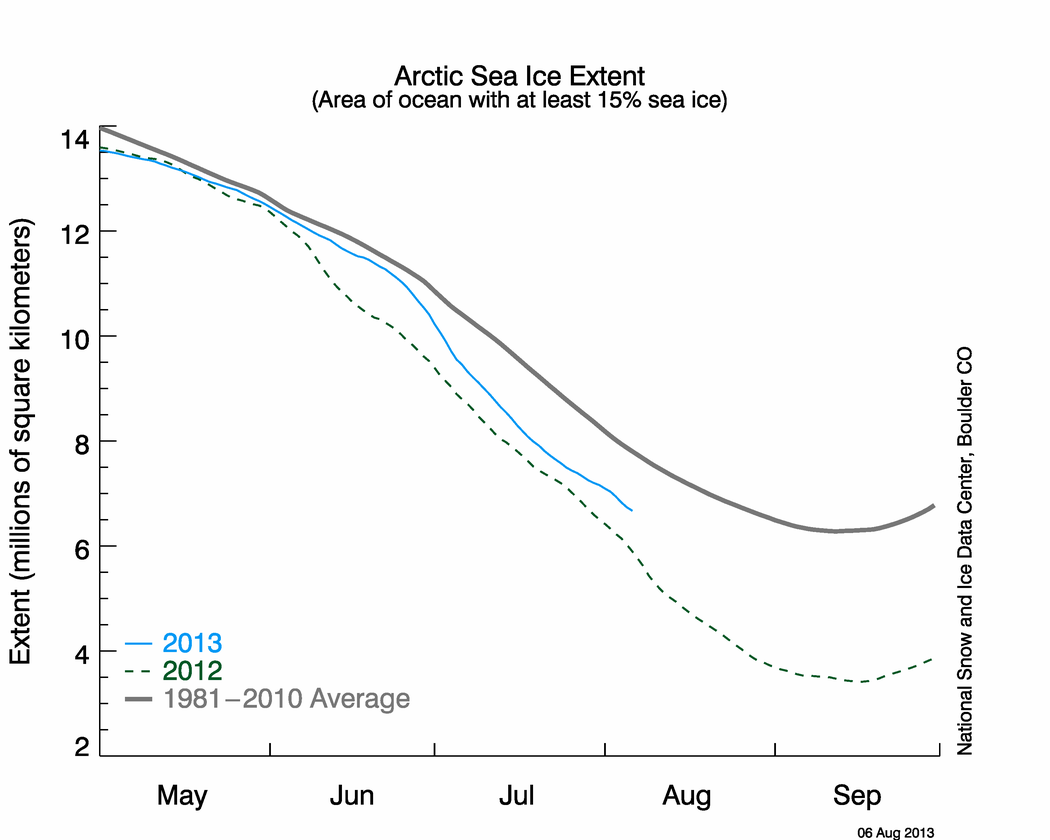
But note what constitutes "long term" for NSIDC. 1979 through 2000. That's 22 years. The originating date is the start of satellite observations. No problem there, but the usual definition of a climate average is 30 years. NSIDC could have done that.
But they don't. If they did, they would include the years of the past decade that were below the first 20 years and that line would drop. If it were to drop, then the difference between what we now have and the average wouldn't be as scary. In fact, in 2010, it would show us to be above the 30-year average.
So why doesn't this government agency present the data in the most scientifically objective manner? If you don't know the answer, you haven't been paying attention.
Sunday, February 28, 2010
Not unprecedented warming, even in last century
I was just looking at the Key Indicators page from NASA, which shows global temperatures over the past 130 years. The smoothed line is based on a 5-year mean, which is arbitrary so this analysis should be taken only as a first-order calculation.
But it's clear that from 1880 to around 1915, nothing much happened. Then for the next 25 years, temperatures rose rapidly, roughly .4C. After which 40 years of very little change (actually a small decline) and then 25 years of rapid increase. Looks like just about .5C during the period. Due to the 5-year mean, data since 2005 is incomplete and not shown, but eyeballing, it seems to have leveled off.
Nobody of any credibility denies that we have warmed somewhat in the past 150 years, although some reasonable people think the rise is exaggerated by changes in land use. However, even taking NASA's numbers (not suggesting that they originated them), the pattern since 1880 makes the CO2 theory a little dicey. We had decadal periods with, respectively no rise, a sharp rise, no rise, and a sharp rise. The sharp rises took place in periods when CO2 was not a significant driver and when it was. The placid periods included a pre-AGCO2 period and one during which CO2 was rising rapidly. The CO2 "signal" isn't evident.
You can always fix this with a computer model by declaring a CO2 signal, subtracting it from the recorded numbers, and identifying whatever remains as natural variation. However, the argument that the increase can only be manmade CO2 emissions because the pattern is unprecedented doesn't stand up.
But it's clear that from 1880 to around 1915, nothing much happened. Then for the next 25 years, temperatures rose rapidly, roughly .4C. After which 40 years of very little change (actually a small decline) and then 25 years of rapid increase. Looks like just about .5C during the period. Due to the 5-year mean, data since 2005 is incomplete and not shown, but eyeballing, it seems to have leveled off.
Nobody of any credibility denies that we have warmed somewhat in the past 150 years, although some reasonable people think the rise is exaggerated by changes in land use. However, even taking NASA's numbers (not suggesting that they originated them), the pattern since 1880 makes the CO2 theory a little dicey. We had decadal periods with, respectively no rise, a sharp rise, no rise, and a sharp rise. The sharp rises took place in periods when CO2 was not a significant driver and when it was. The placid periods included a pre-AGCO2 period and one during which CO2 was rising rapidly. The CO2 "signal" isn't evident.
You can always fix this with a computer model by declaring a CO2 signal, subtracting it from the recorded numbers, and identifying whatever remains as natural variation. However, the argument that the increase can only be manmade CO2 emissions because the pattern is unprecedented doesn't stand up.
Saturday, February 27, 2010
Thomas Friedman is Naive
In a recent conversation with Christiane Amanpour, Thomas Friedman of the New York Times commented about how we should take strong action against a 1% chance of catastrophy. Also today, I've read that medical researchers doubt that all old men should take daily aspirin, because there may be no clear margin of benefit.
That's another story, but consider the difference in views. Friedman is prepared to spend wildly on the off chance that it will be needed. He sees no downside, just the positives of a cleaner environment and new technologies.
There are huge downsides. One is that government-sponsored research will be ineffective and will be distributed politically. The view that there is unlimited money available for research so whatever increment we achieve is a positive, is simply naive.
The other risk is that governments will gain extra power combating global warming and, coming to enjoy it, will decide not to relinquish it. We have avoided the world that George Orwell foresaw in 1984, because one of the superpowers resisted the encroachment of government.
In the new world order, people like Joe Romm will enjoy added influence. If you asked me whether that frightens me more than an extra couple degrees of heat, I wouldn't hesitate for a minute.
That's another story, but consider the difference in views. Friedman is prepared to spend wildly on the off chance that it will be needed. He sees no downside, just the positives of a cleaner environment and new technologies.
There are huge downsides. One is that government-sponsored research will be ineffective and will be distributed politically. The view that there is unlimited money available for research so whatever increment we achieve is a positive, is simply naive.
The other risk is that governments will gain extra power combating global warming and, coming to enjoy it, will decide not to relinquish it. We have avoided the world that George Orwell foresaw in 1984, because one of the superpowers resisted the encroachment of government.
In the new world order, people like Joe Romm will enjoy added influence. If you asked me whether that frightens me more than an extra couple degrees of heat, I wouldn't hesitate for a minute.
An interesting concept of "independence"
I usually excerpt that reference other articles, but today's story about the new independent review of IPCC should be examined end to end:
NUSA DUA, Indonesia (Reuters) — An independent board of scientists will be appointed to review the workings of the world’s top climate science panel, which has faced recriminations over inaccuracies in a 2007 report, a United Nations environmental spokesman said Friday.
We were also told that the IPCC would use purely reviewed science. They haven't and rather than explain why this is not important, they are explaining why it is convenient. Because evidently it allows them to discuss things that aren't fully understood. Since this is indeed a document relied upon by international policy makers, why this is an advantage is not clear.
We are all getting tired of counting large numbers, which are supposed to prove reliability. This is a government report. Does anyone truly believe that there would be any problem finding 10,000 papers funded by governments which would support the government view, particularly since future funding depends on doing so?
Meanwhile Reuters, maintaining its legendary objectivity, divides the believers and unbelievers into two camps, described as "mainstream scientists and the United Nations," on the one hand, and "some quarters," in opposition.
Based on this, it's reasonable to suppose that the composition of the "independent" review panel will be chosen by the same people who chose the IPCC. Perhaps not the IPCC exactly, but people with a vested interest in confirming it. It's like the defense being able to choose the jury without consulting the prosecution. I'm nearly certain that Steve McIntyre will not be asked to participate, or even consulted on who should.
Another whitewash is underway. Penn State has delivered one for Professor Mann. The "respectable" scientists will do one for IPCC. But in the end, the problems remain. Temperatures are not rising. A lot of snow is in fact falling. Arctic ice is not changing much. CO2 and global sea levels are trending below the straight line, rather than rising above as we've been warned to expect. Hurricane seasons have been unimpressive.
Sooner or later, the warmists are going to have to deliver something more attention grabbing than CO2 concentrations, or Copenhagen is going to mark the high water mark of their influence, rather than just another step towards the goal.
NUSA DUA, Indonesia (Reuters) — An independent board of scientists will be appointed to review the workings of the world’s top climate science panel, which has faced recriminations over inaccuracies in a 2007 report, a United Nations environmental spokesman said Friday.
The board’s work will be part of a broader review of the body, the Intergovernmental Panel on Climate Change, said Nick Nuttall, a spokesman for the United Nations Environment Program, who spoke on the sidelines of an international meeting of environment ministers here.
The Intergovernmental Panel on Climate Change has been under fire since it was pointed out that the 2007 report included a prediction that Himalayan glaciers would vanish by 2035, although there is no scientific consensus to that effect.
That brief citation — drawn from a magazine interview with a glaciologist who says he was misquoted — and sporadic criticism of the panel’s leader have fueled skepticism in some quarters about the science underlying climate change. The climate panel’s assessments are a crucial source of guidance for policy makers addressing global warming.
But mainstream scientists and the United Nations have said repeatedly that the evidence that human activity is a major factor in global warming remains unshaken.
Mr. Nuttall said the review body would be made up of “senior scientific figures” who could perhaps produce a report by late summer for consideration at a meeting of the climate panel in October in South Korea.
He said that several countries had made clear at the meeting here in Bali that they would prefer that the review panel be appointed by an independent group of scientists rather than the climate panel. He said that plans for assembling the panel would be announced next week.
“I think we are bringing some level of closure to this issue,” Mr. Nuttall said.
One area to be examined is whether the panel should incorporate so-called gray literature, a term to describe nonpeer-reviewed science, in its reports.
Many scientists say that such material, ranging from reports by government agencies to respected research not published in scientific journals, is crucial to seeking a complete picture of the state of climate science.
Achim Steiner, executive director of the United Nations Environment Program, told reporters here this week that he did not support a ban on the use of gray literature and that the news media had overblown the climate panel’s missteps.
The 2007 report on climate change cites more than 10,000 scientific papers and is more than 3,000 pages long.
So much to discuss. First, the IPCC report has been under fire for much longer than the Himalaya fiasco, and its problem is not a lack of consensus to support it. There isn't an iota of evidence to support it and there isn't a credible individual who supports it.We were also told that the IPCC would use purely reviewed science. They haven't and rather than explain why this is not important, they are explaining why it is convenient. Because evidently it allows them to discuss things that aren't fully understood. Since this is indeed a document relied upon by international policy makers, why this is an advantage is not clear.
We are all getting tired of counting large numbers, which are supposed to prove reliability. This is a government report. Does anyone truly believe that there would be any problem finding 10,000 papers funded by governments which would support the government view, particularly since future funding depends on doing so?
Meanwhile Reuters, maintaining its legendary objectivity, divides the believers and unbelievers into two camps, described as "mainstream scientists and the United Nations," on the one hand, and "some quarters," in opposition.
Based on this, it's reasonable to suppose that the composition of the "independent" review panel will be chosen by the same people who chose the IPCC. Perhaps not the IPCC exactly, but people with a vested interest in confirming it. It's like the defense being able to choose the jury without consulting the prosecution. I'm nearly certain that Steve McIntyre will not be asked to participate, or even consulted on who should.
Another whitewash is underway. Penn State has delivered one for Professor Mann. The "respectable" scientists will do one for IPCC. But in the end, the problems remain. Temperatures are not rising. A lot of snow is in fact falling. Arctic ice is not changing much. CO2 and global sea levels are trending below the straight line, rather than rising above as we've been warned to expect. Hurricane seasons have been unimpressive.
Sooner or later, the warmists are going to have to deliver something more attention grabbing than CO2 concentrations, or Copenhagen is going to mark the high water mark of their influence, rather than just another step towards the goal.
Friday, February 12, 2010
Warming is causing snow
OK, I'll buy the argument that heavy snow in Philly is the result of cold-enough temperatures and unusually moisture-laden air. But now we're getting in in the Deep South. They don't normally get snow now due to lack of moisture but lack of cold. This simply suggests we're having a severe February, that can't be explained by any flavor of global warming.
Those of us in the skeptic, not denier, camp don't object to the consistent use of science in support of public policy positions, but we get a little tired when heat waves in Europe, Katrina, and so forth are quickly attributed to AGW, but snow in Atlanta and record snow in Britain just mark a blip or even another consequence of AGW that nobody had thought to mention before. At least before 1998. With the failure of consistent warming to appear, there have been some "everything is due to AGW" warnings, but increasingly frequent blizzards haven't been mentioned that I recall.
A little consistency would be nice.
Those of us in the skeptic, not denier, camp don't object to the consistent use of science in support of public policy positions, but we get a little tired when heat waves in Europe, Katrina, and so forth are quickly attributed to AGW, but snow in Atlanta and record snow in Britain just mark a blip or even another consequence of AGW that nobody had thought to mention before. At least before 1998. With the failure of consistent warming to appear, there have been some "everything is due to AGW" warnings, but increasingly frequent blizzards haven't been mentioned that I recall.
A little consistency would be nice.
Tuesday, February 02, 2010
Our linguiistic losses
Old people like me can only shake our heads at learning that Sarah Palin is criticizing Rahm Emanuel for calling people he disagreed with f*cking retarded in a conversation not intended for general public consumption. Not for "f*cking", which would have got you sent to detention when I was in school, but "retarded."
"Retarded" is a euphemism. It means "stupid," and was devised by well meaning people who didn't want to call stupid people "stupid." Unfortunately, as with so many euphemisms, after time it becomes associated with reality and people start to use it as such. Then we decide we won't call stupid people "retarded" either.
Now we have moved to "challenged," which has already moved to the joke level and will sooner or later become an insult. There is a silver lining to this. Eventually, the original words become so dissociated with reality that nobody remembers and they can be used freely. For instance, nobody complains if you call an idea "lame" or a person an "emotional cripple," although both words succumbed to euphemisms generations ago.
Maybe like Gaia, the English language has built-in response mechanisms to attacks on its integrity.
"Retarded" is a euphemism. It means "stupid," and was devised by well meaning people who didn't want to call stupid people "stupid." Unfortunately, as with so many euphemisms, after time it becomes associated with reality and people start to use it as such. Then we decide we won't call stupid people "retarded" either.
Now we have moved to "challenged," which has already moved to the joke level and will sooner or later become an insult. There is a silver lining to this. Eventually, the original words become so dissociated with reality that nobody remembers and they can be used freely. For instance, nobody complains if you call an idea "lame" or a person an "emotional cripple," although both words succumbed to euphemisms generations ago.
Maybe like Gaia, the English language has built-in response mechanisms to attacks on its integrity.
Arctic Ice and Solar Cycle
The gurus of solar cycles were wrong about the timing of Cycle 24, but the sun seems to be kicking up and we're clearly on the rise. Whether we reach the oft-revised target date and intensity, I wouldn't hazard a guess. My interest was always a bit quirky, based mostly on my irritation that people were positively denying possibilities that were real, but I had no real idea why sunspots might affect climate. The Arizona guys were saying that it's the next cycle that will go really quiet, not this one, so we're a few years away from seeing if they're right.
Meantime, the Danish measurements of far North temperatures show somewhat colder weather this January than in the recent past, but the Japanese data on ice extent shows no clear pattern. The multi-year graph still looks like spaghetti. I'm guessing that September will be much like last September, which will disappoint Al Gore.
Also Time Magazine which has run an alarmist story about how ice in the Beaufort Sea seems thin. It's pretty close to a "duh" moment. The researcher discovered this in October. In mid October, the ice extent had grown by about 50% from the September low. On the edge, naturally, so if you take an ice breaker into the ice, you will first encounter thin new ice. This is surprising? That observation is accompanied by additional, unscientific observations of an ad hoc nature.
The author writes for a warmist Web site. I think when someone whose career depends on the success of AGW writes about global warming, there should be some sort of warning label.
Meantime, the Danish measurements of far North temperatures show somewhat colder weather this January than in the recent past, but the Japanese data on ice extent shows no clear pattern. The multi-year graph still looks like spaghetti. I'm guessing that September will be much like last September, which will disappoint Al Gore.
Also Time Magazine which has run an alarmist story about how ice in the Beaufort Sea seems thin. It's pretty close to a "duh" moment. The researcher discovered this in October. In mid October, the ice extent had grown by about 50% from the September low. On the edge, naturally, so if you take an ice breaker into the ice, you will first encounter thin new ice. This is surprising? That observation is accompanied by additional, unscientific observations of an ad hoc nature.
The author writes for a warmist Web site. I think when someone whose career depends on the success of AGW writes about global warming, there should be some sort of warning label.
When will China begin seriously running US Foreign policy?
It's only a matter of time. They are unhappy that we want to sell arms to Taiwan. How do they expect us to earn the money to buy their poisonous widgets? Now they are disturbed that Obama might meet the Dalai Lama and are expressing their concerns with veiled threats.
When you sell your soul, you eventually have to pay the devil his due. We are addicted to improbable stories of easy benefits. We believe people who say they are honestly generating impossible financial returns and are then shocked when they turn out to be running Ponzi schemes. And we are now believing that the Chinese are beneficently letting us enjoy the fruits of their manufacturing labor with no expectation of eventual payment.
They will want payment. The veil is rising. They are tired of the United States exercising an independent foreign policy that may conflict with theirs, and it won't be long before the President realizes that he can't meet the Dalai Lama if our primary banker says we can't.
When you sell your soul, you eventually have to pay the devil his due. We are addicted to improbable stories of easy benefits. We believe people who say they are honestly generating impossible financial returns and are then shocked when they turn out to be running Ponzi schemes. And we are now believing that the Chinese are beneficently letting us enjoy the fruits of their manufacturing labor with no expectation of eventual payment.
They will want payment. The veil is rising. They are tired of the United States exercising an independent foreign policy that may conflict with theirs, and it won't be long before the President realizes that he can't meet the Dalai Lama if our primary banker says we can't.
Abstinence only works with the right question
The new "abstinence only" sex education report is supposed to be surprising. Leaving aside the small sample size, only about 600 divided into four groups, there is the oddity about condom use. Teaching about the advantages of condom use and disadvantages of unprotected sex should have had an impact. According to the report, it didn't. That fact raises a red flag.
However, a larger question is the methodology. How do we know they're not having sex? They say they aren't. Since no data is given on the results from students not involved in the study, the presumption is that only students in the study were asked, so they presumably knew they were being asked by the same people who had been instructing them.
So picture the situation. Child A has been getting instruction in safe sex. He is asked whether he's been having sex. He says yes. Child B has been getting instruction to the effect that sex is intrinstically unsafe. He is asked whether he has disregarded the instruction. He says no. Is this scientific?
Fewer than 100 girls took part in each group. I will be more impressed if, at the end of the ninth grade, it were to be calculated how many in each group got pregnant. Having sex is not a public health issue. Getting pregnant or spreading STDs is, and since the practice that brings them about is the same, the quickest test for that is objectively observing pregnancy rates. The jury is still out.
However, a larger question is the methodology. How do we know they're not having sex? They say they aren't. Since no data is given on the results from students not involved in the study, the presumption is that only students in the study were asked, so they presumably knew they were being asked by the same people who had been instructing them.
So picture the situation. Child A has been getting instruction in safe sex. He is asked whether he's been having sex. He says yes. Child B has been getting instruction to the effect that sex is intrinstically unsafe. He is asked whether he has disregarded the instruction. He says no. Is this scientific?
Fewer than 100 girls took part in each group. I will be more impressed if, at the end of the ninth grade, it were to be calculated how many in each group got pregnant. Having sex is not a public health issue. Getting pregnant or spreading STDs is, and since the practice that brings them about is the same, the quickest test for that is objectively observing pregnancy rates. The jury is still out.
Subscribe to:
Posts (Atom)